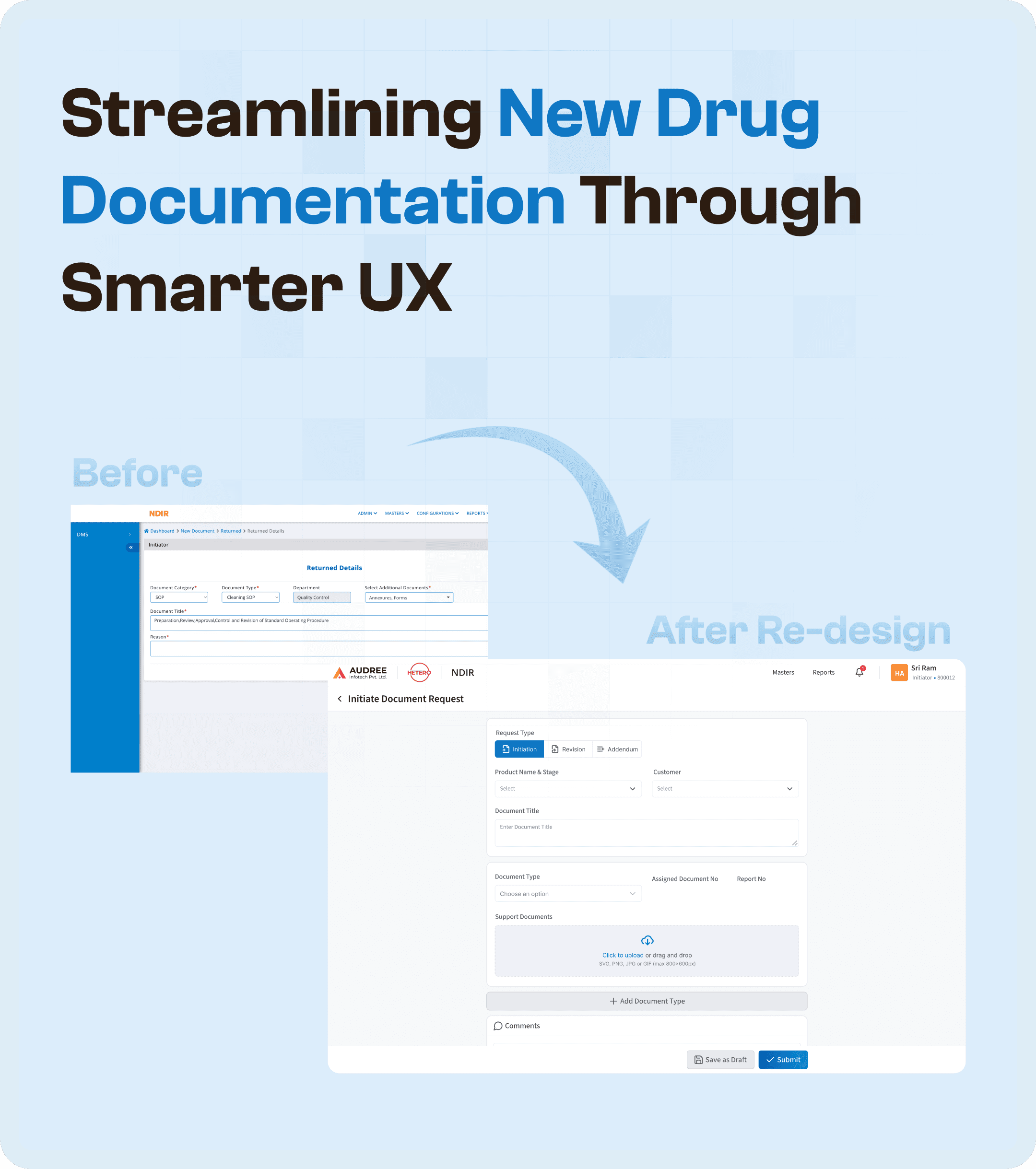

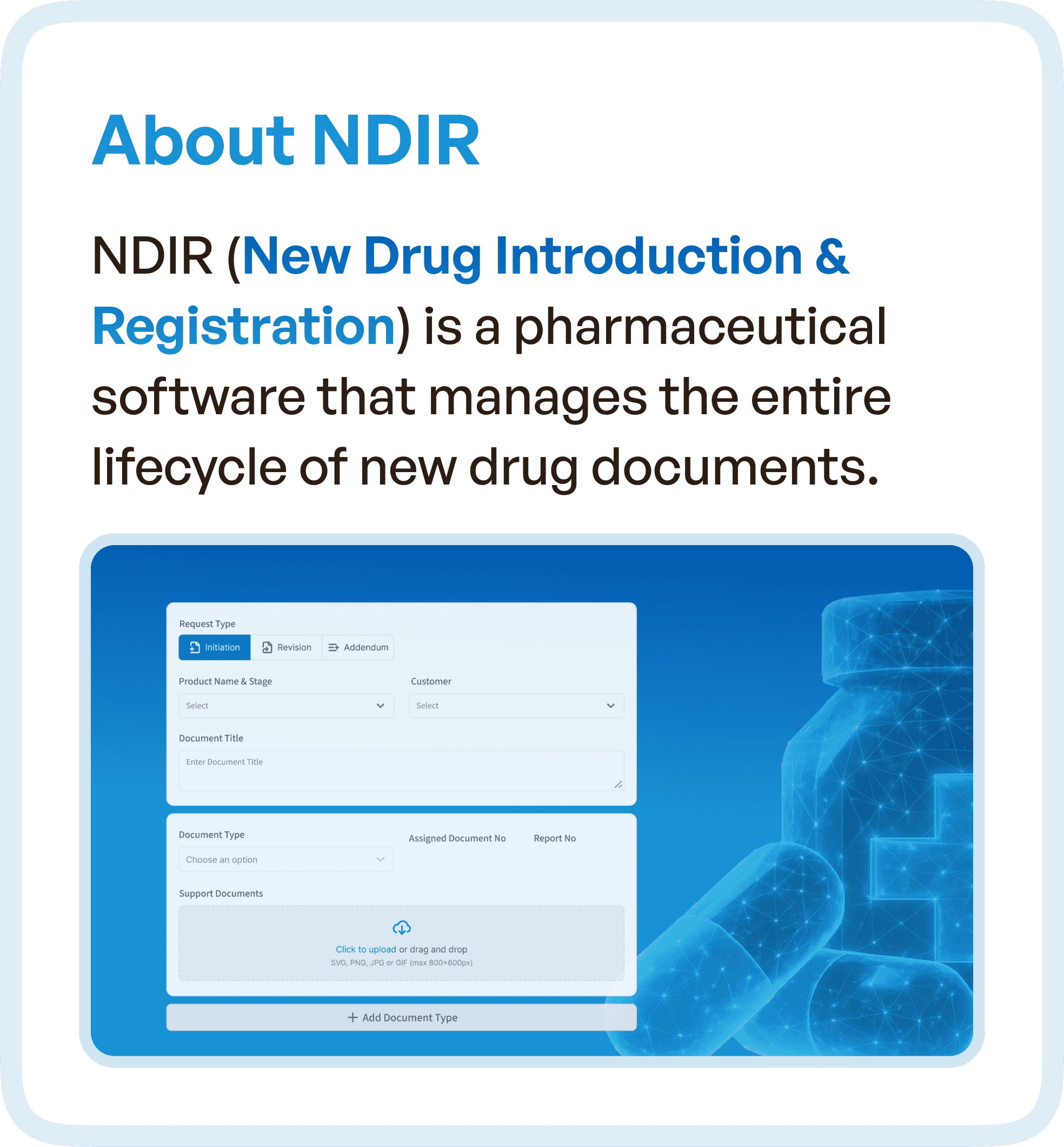
The Hidden Problem in NDIR Systems
When we analyzed the existing NDIR platform, the challenges were not immediately visible at a surface level.
The system technically worked.
But in practice, users struggled.
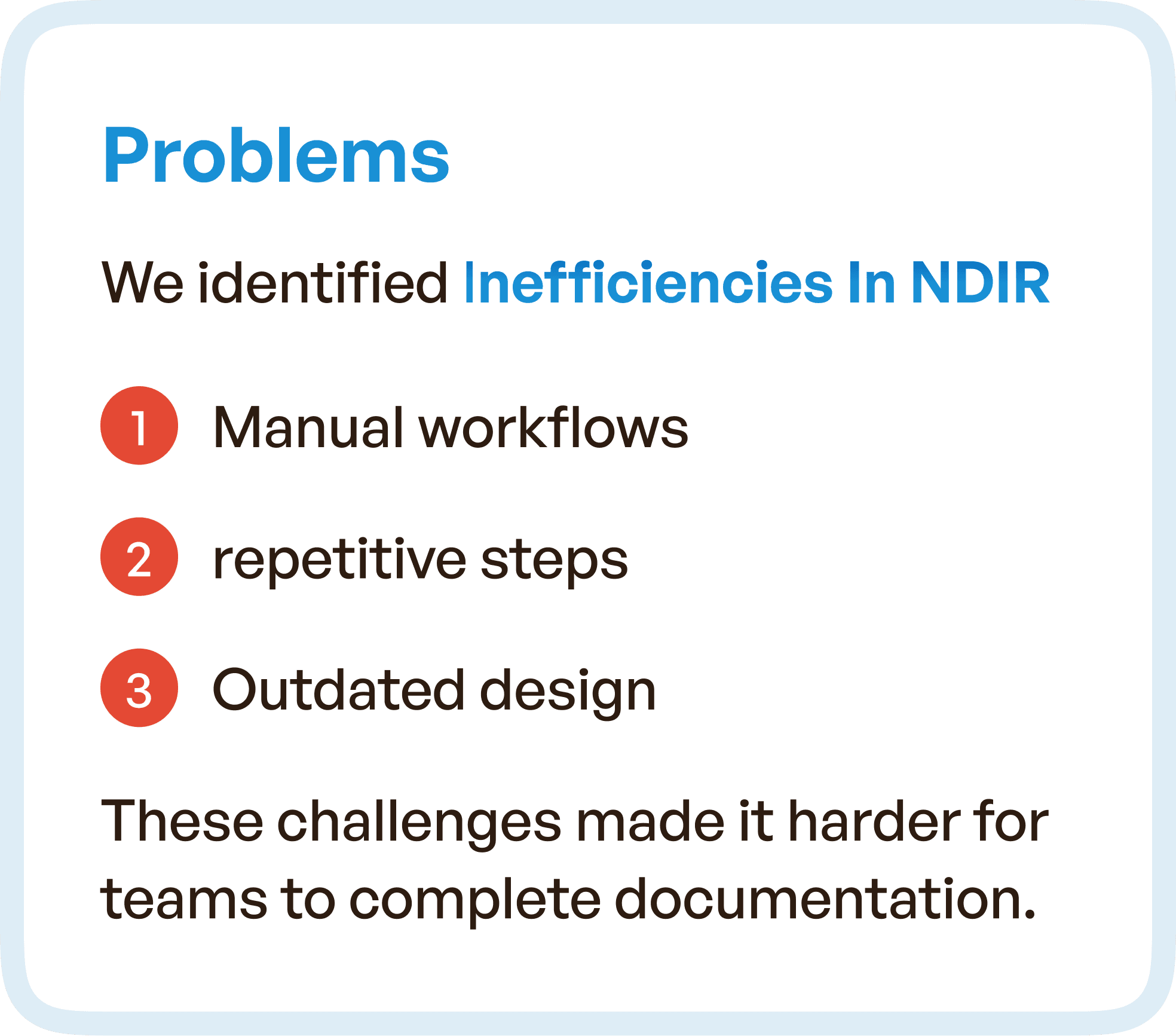
Manual workflows dominated the process, requiring teams to handle multiple disconnected steps. Repetitive actions increased effort without adding value. The interface itself felt outdated, making it harder for users to navigate and understand what to do next.
This created a situation where completing documentation was not just time-consuming, but mentally taxing.
In regulated environments like pharma, this is a serious issue.
Because inefficiency does not just slow teams down — it impacts accuracy and compliance.
Understanding the Business Challenges
As we mapped the workflows and spoke to users, deeper structural problems became clear.
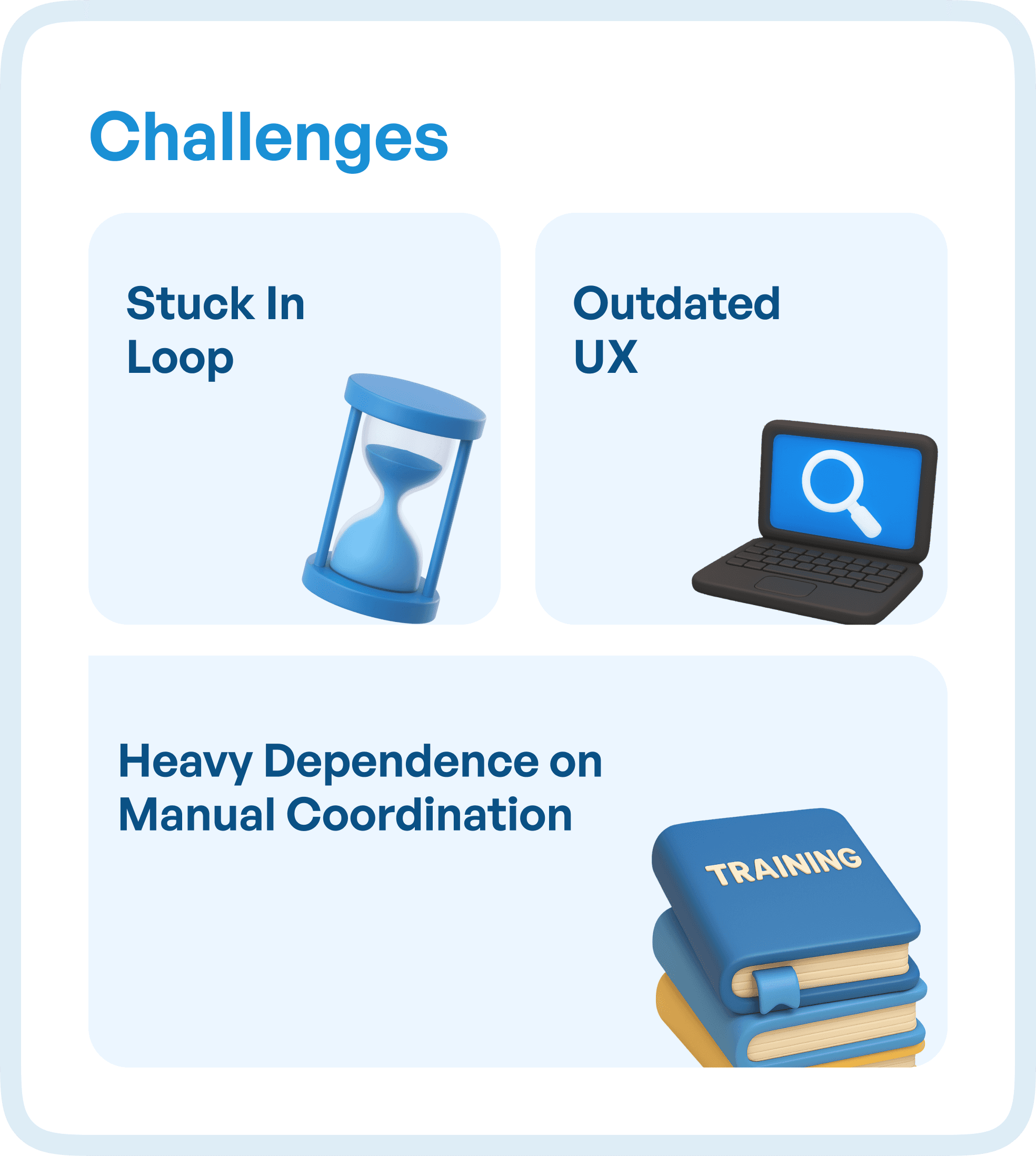
Teams were often stuck in loops, moving back and forth between stages without clear progression. The lack of structured flow meant that users had to rely on memory instead of guidance.
There was also a heavy dependence on manual coordination. Teams had to communicate outside the system to complete tasks, which broke continuity and increased the chances of errors.
Training became a necessity rather than an option. New users could not navigate the system confidently without external support.
These are classic indicators of poor workflow design, not just poor UI.
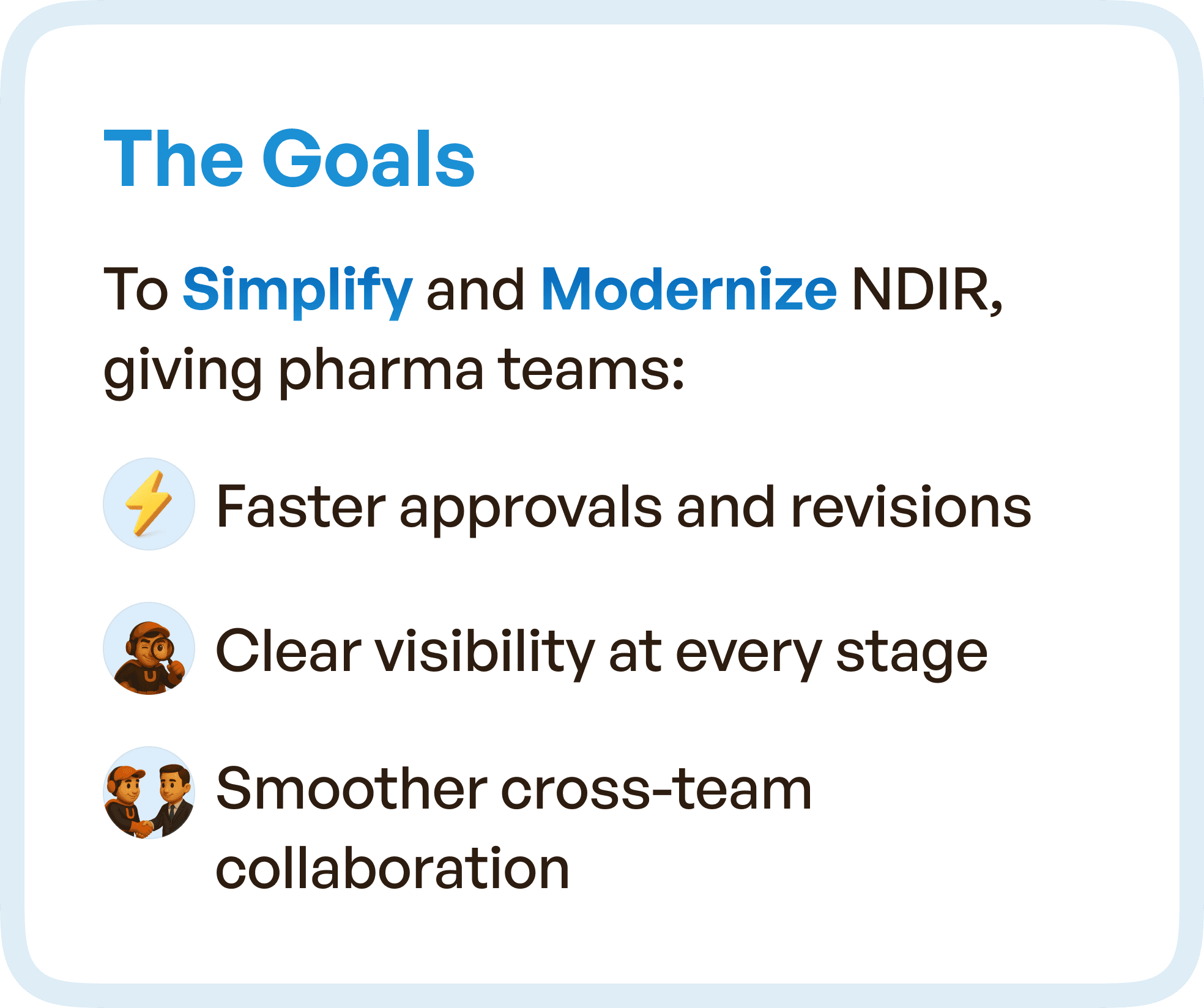
Defining the Goal: Simplify and Modernize
The objective was not to redesign screens.
It was to restructure how the system works.
We focused on simplifying the NDIR lifecycle by:
Reducing unnecessary steps
Improving visibility across stages
Enabling smoother collaboration between teams
The goal was to create a system where users no longer had to figure things out manually, but were instead guided through the process.
Transforming Fragmented Workflows into a Structured System
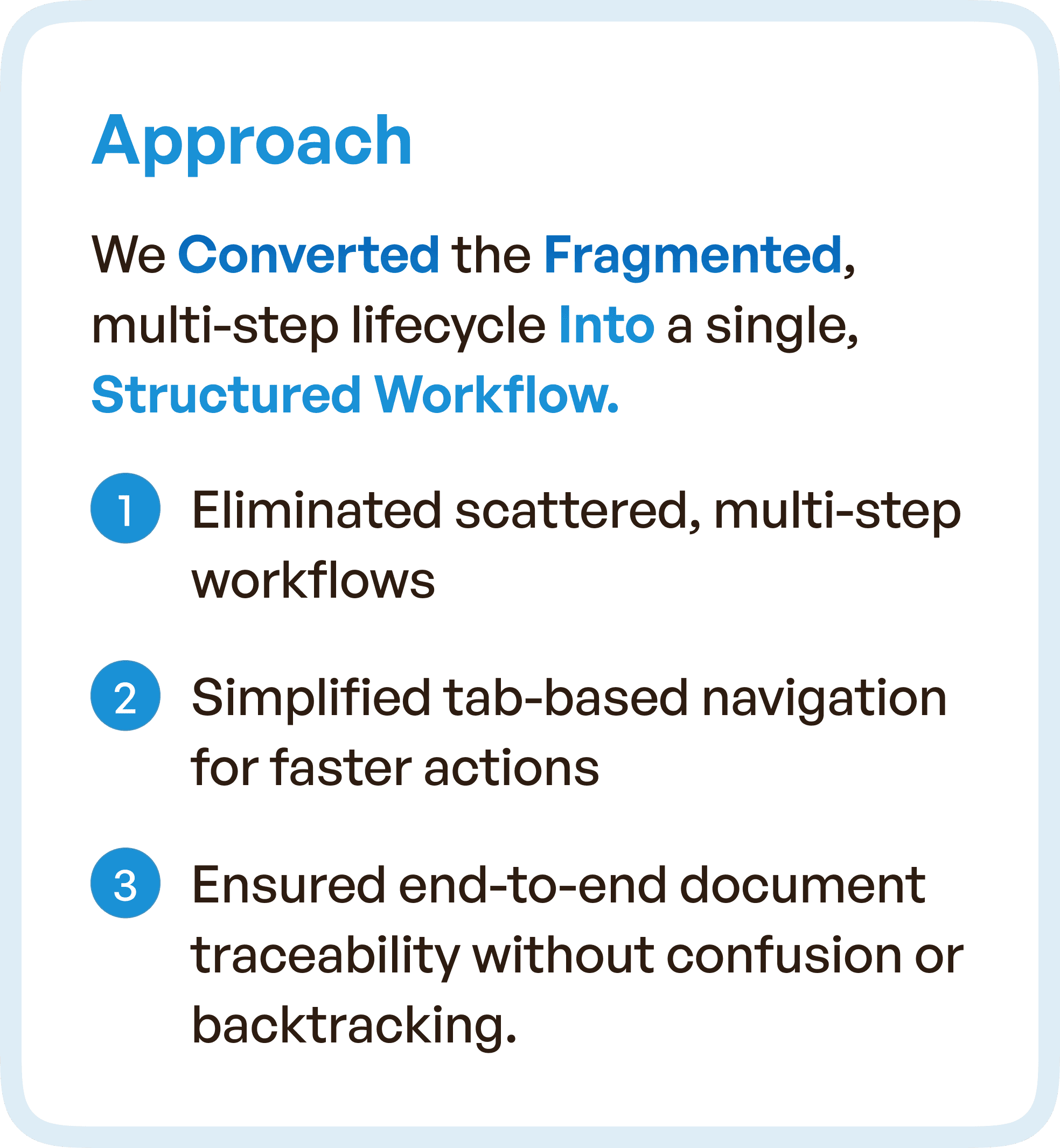
The biggest shift in this project came from changing the architecture of the experience.
Instead of multiple disconnected flows, we designed a single, structured workflow that aligned with how documentation actually progresses in real-world scenarios.
Scattered steps were consolidated into a cohesive flow. Navigation was simplified using a tab-based structure, allowing users to move between stages quickly without losing context.
Most importantly, the system ensured end-to-end traceability.
Users could clearly see where they were in the process, what had been completed, and what needed to happen next — without backtracking or confusion.
This removed the dependency on external coordination and brought everything into a unified system.
Designing for Clarity, Not Just Completion
Once the structure was in place, the interface was designed to support clarity at every step.
Smart fields were introduced to reduce manual input and guide users through required actions. Each stage of the lifecycle was clearly defined, ensuring that users always understood their current position within the workflow.
Version transparency was built into the system, allowing teams to track changes without confusion. This is especially critical in pharmaceutical environments where documentation accuracy and traceability are non-negotiable.
The result was a context-rich interface — one that adapts to the user’s stage and provides relevant information without overwhelming them.

The Impact: From Effort-Heavy to Efficient
The redesigned NDIR system significantly improved how teams interacted with the platform.
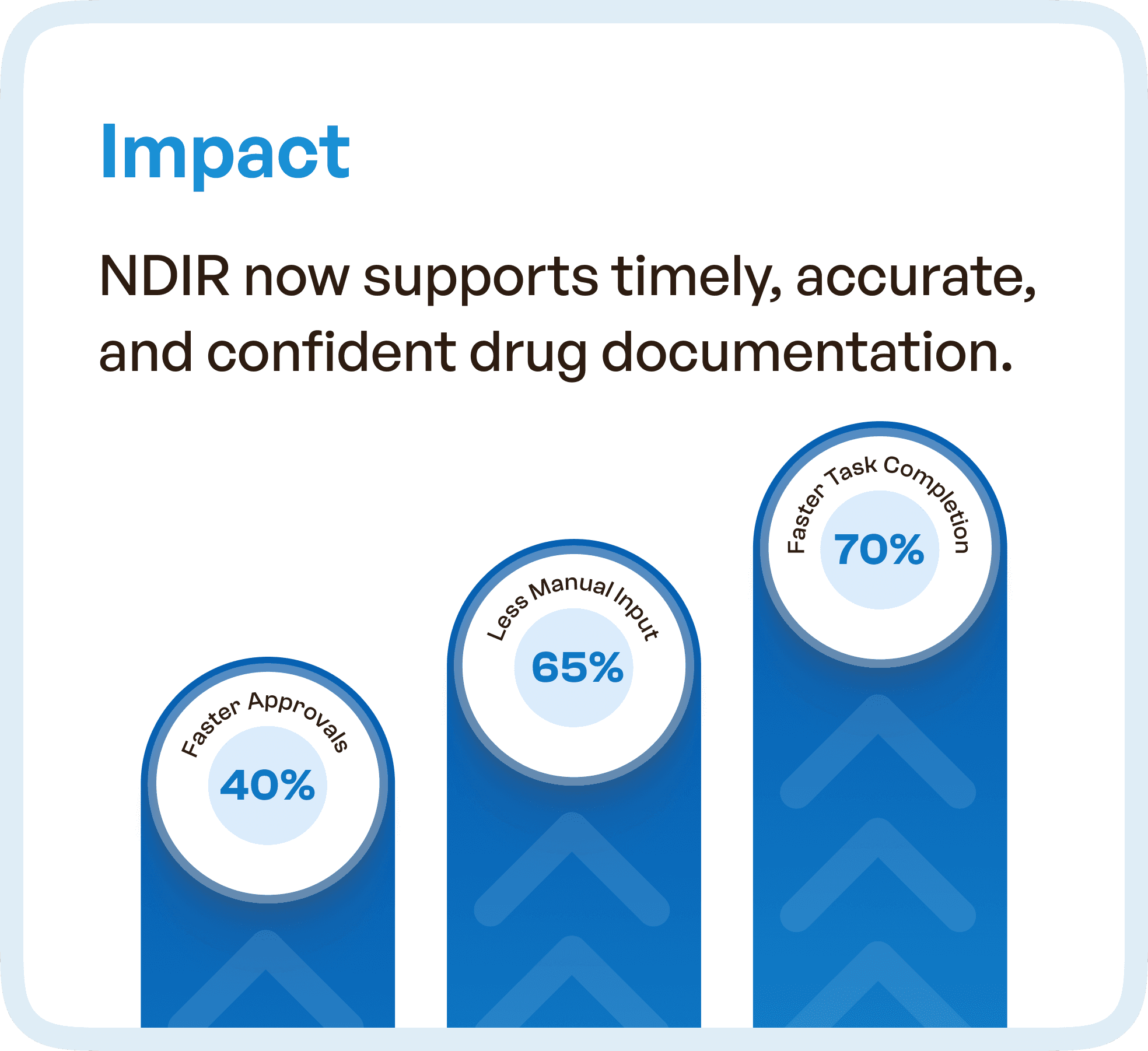
Tasks that previously required multiple steps and external coordination became streamlined within a single flow. Users were able to complete documentation faster, with fewer errors and greater confidence.
Approvals became quicker due to better visibility and structured progression. Manual effort reduced as the system began guiding users instead of relying on them to navigate complexity.
Most importantly, the experience became predictable.
And in enterprise systems, predictability leads to efficiency.
Why This Matters for Pharmaceutical and Enterprise Software
NDIR systems are just one example.
Across enterprise and regulated industries, many systems suffer from the same issue:
They are built to handle complexity, but not designed to manage it.
Over time, this leads to:
Fragmented workflows
Increased training dependency
Slower task completion
Higher chances of error
The solution is not adding more features or redesigning the UI layer.
It is rethinking the workflow structure.
Because when the flow is clear, the system becomes easier to use — regardless of its complexity.
How Upslide Design Studio Approaches UX Optimization
At Upslide Design Studio, we focus on structural UX improvements, not just visual redesigns.
Our approach involves:
Understanding real user workflows
Identifying inefficiencies across stages
Restructuring systems into guided flows
Designing interfaces that support clarity and speed
This ensures that enterprise products are not only functional, but also efficient, scalable, and easy to adopt.
Final Thought
In systems like NDIR, the challenge is not complexity.
The challenge is how that complexity is presented to users.
When workflows are fragmented, users struggle.
When workflows are structured, users succeed.
Because ultimately, users don’t experience your system as a set of screens.
They experience it as a process.
And improving that process is where UX creates real impact.