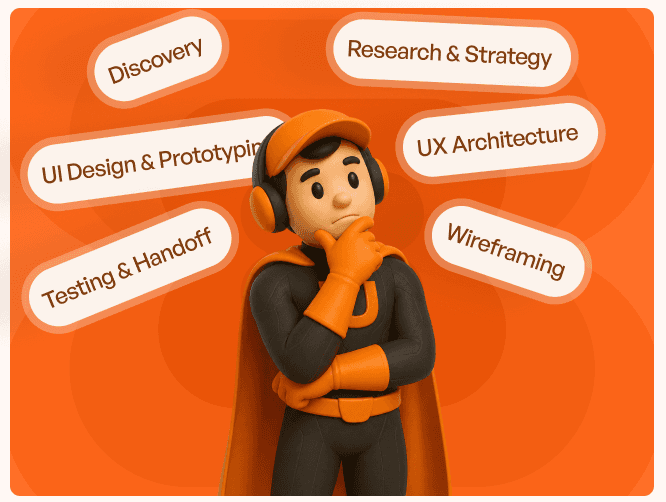
Why Designers Are Worried About AI
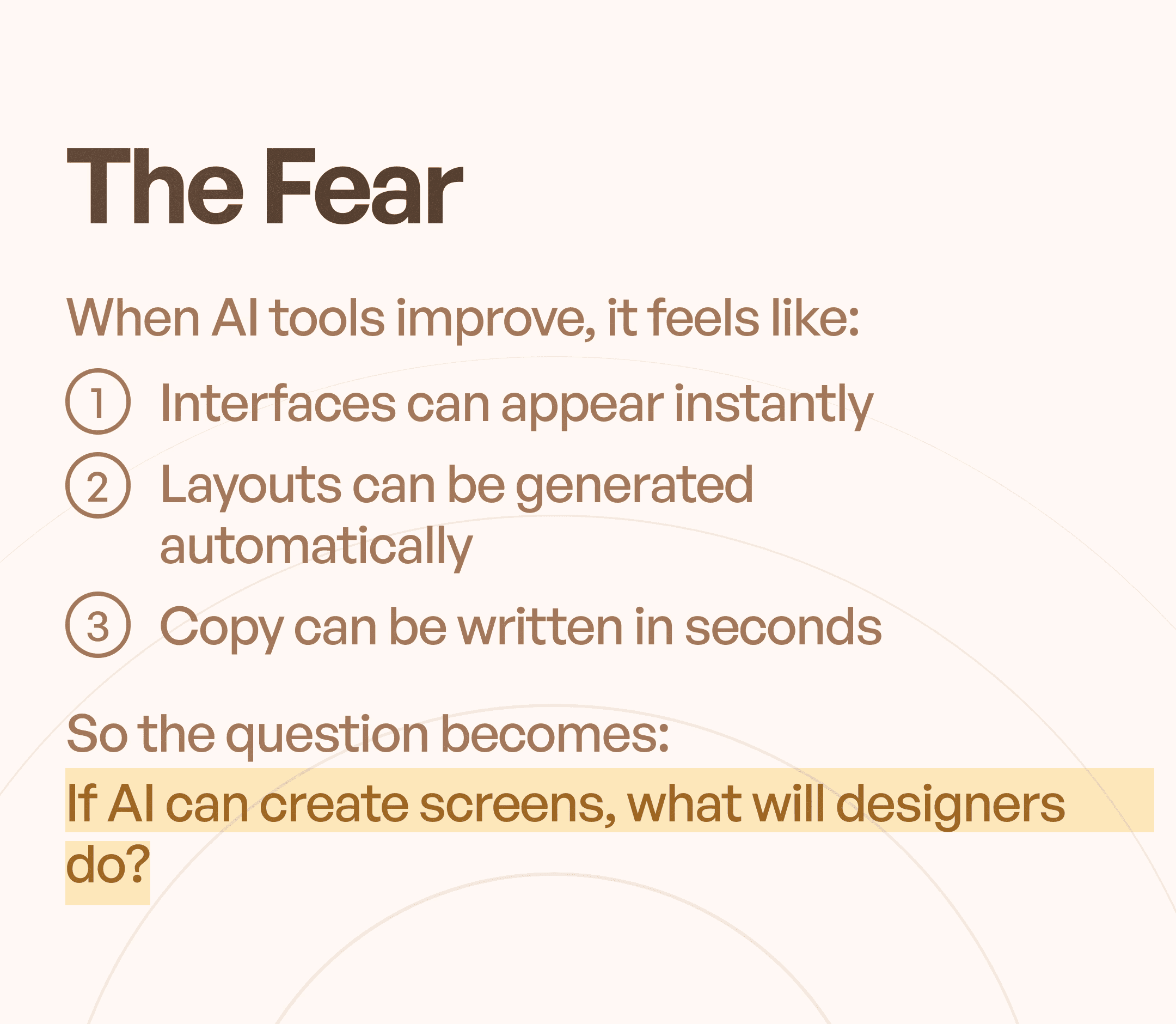
The fear surrounding AI in design is understandable.
Modern AI tools can already:
Generate interface layouts
Create multiple UI variations
Suggest design systems
Write UX copy
Build wireframes
Automate repetitive tasks
For designers who mainly focus on producing screens quickly, this shift can feel threatening.
If AI can generate interfaces in seconds, what happens to the designer?
The answer lies in understanding what design actually is.
Because design is far bigger than arranging components on a screen.
The Reality: AI Is a Tool, Not a Product Thinker
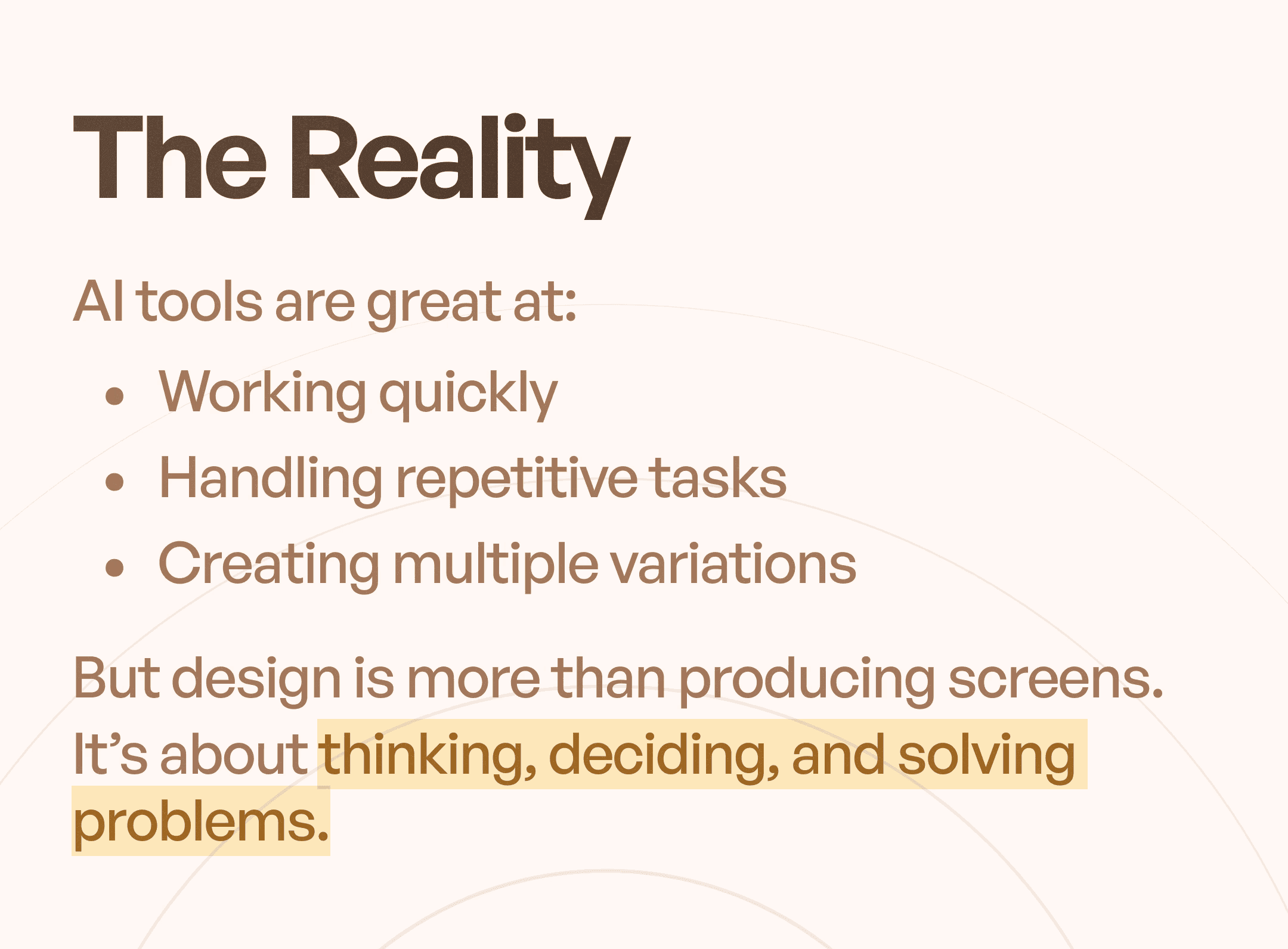
AI tools are becoming extremely efficient at execution.
They are great for:
Speeding up workflows
Automating repetitive actions
Exploring variations
Reducing production time
Assisting with layouts and consistency
But generating screens is only one small part of product design.
Real UX work involves:
Understanding user behavior.
Balancing business goals.
Mapping workflows.
Identifying friction.
Making strategic decisions.
Solving operational problems.
AI can assist with output.
But it still struggles with deep contextual thinking.
And contextual thinking is where experienced designers create the most value.
What Figma AI Can Actually Do
Figma AI and similar tools are reshaping UI workflows significantly.
AI-powered features may include:
Auto-generating layouts
Creating design suggestions
Organizing layers
Writing placeholder content
Building component variations
Generating quick prototypes
This improves efficiency.
Tasks that previously took hours may now take minutes.
For product teams, this creates faster iteration cycles.
For designers, it removes a large amount of repetitive production work.
Which is actually beneficial.
Because less time spent on repetitive execution means more time available for strategic thinking.
What AI Still Cannot Replace in UX Design
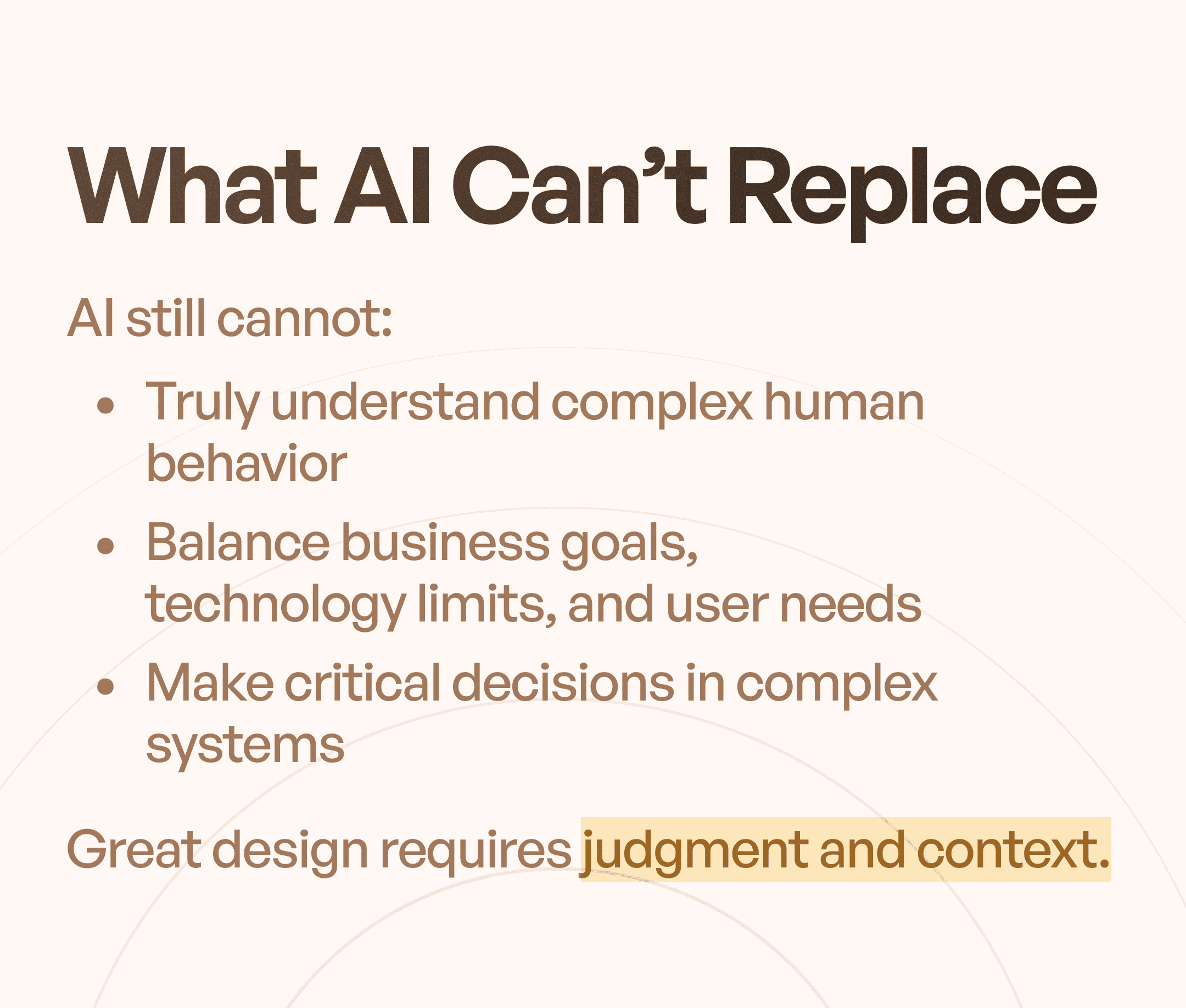
Despite rapid improvements, AI still lacks several critical abilities required in real-world product design.
AI struggles to:
Understand Complex Human Behavior
Users are emotional, unpredictable, and context-driven.
Great UX depends on understanding those behaviors deeply.
Balance Business Goals and User Needs
Product decisions are rarely black and white.
Designers constantly balance:
User expectations
Technical limitations
Business priorities
Operational constraints
AI lacks this nuanced judgment.
Solve Complex Workflow Problems
Enterprise systems, healthcare software, and operational platforms involve highly interconnected workflows.
These require systems thinking—not just visual generation.
Navigate Ambiguity
Real design problems are messy.
Often stakeholders themselves don’t fully understand the problem initially.
Experienced designers uncover hidden friction through research, collaboration, and observation.
AI currently cannot replace this process.
The Real Shift Happening in UX Design
AI is not eliminating design roles.
It is changing what makes designers valuable.
Previously, many designers were hired primarily for execution:
Making screens
Creating mockups
Producing layouts
Now the industry is shifting toward higher-level thinking.
The most valuable designers moving forward will focus on:
UX strategy
Product thinking
Systems design
User psychology
Research
Workflow optimization
Collaboration
The role of designers is evolving from:
“Making screens” → to → “Making decisions.”
This is a major industry transformation.
Designers Who Only Depend on Tools May Struggle
One important reality is emerging:
Execution alone is becoming commoditized.
If a designer’s entire value comes from pushing pixels or following templates, AI tools may eventually replace much of that workflow.
However, designers who can:
Frame problems clearly
Understand industries deeply
Design scalable systems
Simplify complex workflows
Align UX with business goals
will become even more valuable.
This is especially true in industries such as:
Healthcare UX
Enterprise SaaS
AI products
Fintech
Manufacturing systems
Pharmaceutical software
Complex products still require human judgment.
Why Human Collaboration Still Matters
Design is rarely done in isolation.
Product design involves collaboration with:
Stakeholders
Developers
Product managers
Operations teams
Business leaders
End users
Good design often comes from discussions, observations, workshops, and iterative refinement.
AI may generate suggestions.
But human teams still decide:
What matters.
What should be prioritized.
What users actually need.
What risks exist.
What tradeoffs make sense.
That collaborative decision-making process remains deeply human.
AI Will Raise the Standard for Designers
One of the biggest impacts of AI is that it raises expectations.
When basic UI generation becomes easier, companies will expect more from designers.
This means stronger emphasis on:
Strategic thinking
Systems thinking
UX research
Product reasoning
Business understanding
The future designer will likely act more like a product strategist than a screen decorator.
And that’s a positive shift for the industry.
Final Thoughts: AI Will Change Design, Not Eliminate Designers
Figma AI will absolutely reshape the UI/UX industry.
Design workflows will become faster.
Production tasks will become more automated.
Basic interfaces will become easier to generate.
But the demand for thoughtful product thinking will only increase.
Because products are ultimately built for humans.
And understanding humans requires empathy, judgment, context, communication, and strategy.
AI can generate screens.
But great UX still requires people who know why those screens should exist in the first place.