
Most People Think UX Is About Screens
When designers first enter the industry, they often focus on the visible parts of a product.
Things like:
Colors
Buttons
Typography
Icons
Layouts
These elements are important.
But they are not UX design.
They are simply tools used to create an experience.
The real goal of UX design is to remove friction between a user and their goal.
Users don't open Netflix because they want to admire the interface.
They open Netflix because they want to watch something.
Anything that gets in the way of that goal creates friction.
And friction is where UX designers focus their attention.
The Hidden Problem Netflix Identified
Imagine you're watching a series on Netflix.
You finish one episode.
The next episode starts automatically.
The intro plays again.
The first time?
No problem.
The second time?
Still acceptable.
But after watching multiple episodes in a single sitting, repeatedly watching the same intro becomes frustrating.
Not because the intro is bad.
Because it interrupts what users actually want to do.
They want to continue the story.
The intro becomes a small obstacle between the user and their goal.
And millions of users were experiencing that same obstacle every day.
This is where great UX thinking begins.
Great UX Starts by Observing Behavior
The best UX improvements rarely start with design.
They start with observation.
Netflix likely noticed that users frequently fast-forwarded through intros manually.
That behavior revealed something important.
Users were telling Netflix:
"We don't want to watch this every time."
Instead of redesigning the entire interface, Netflix focused on solving that specific frustration.
The result was incredibly simple.
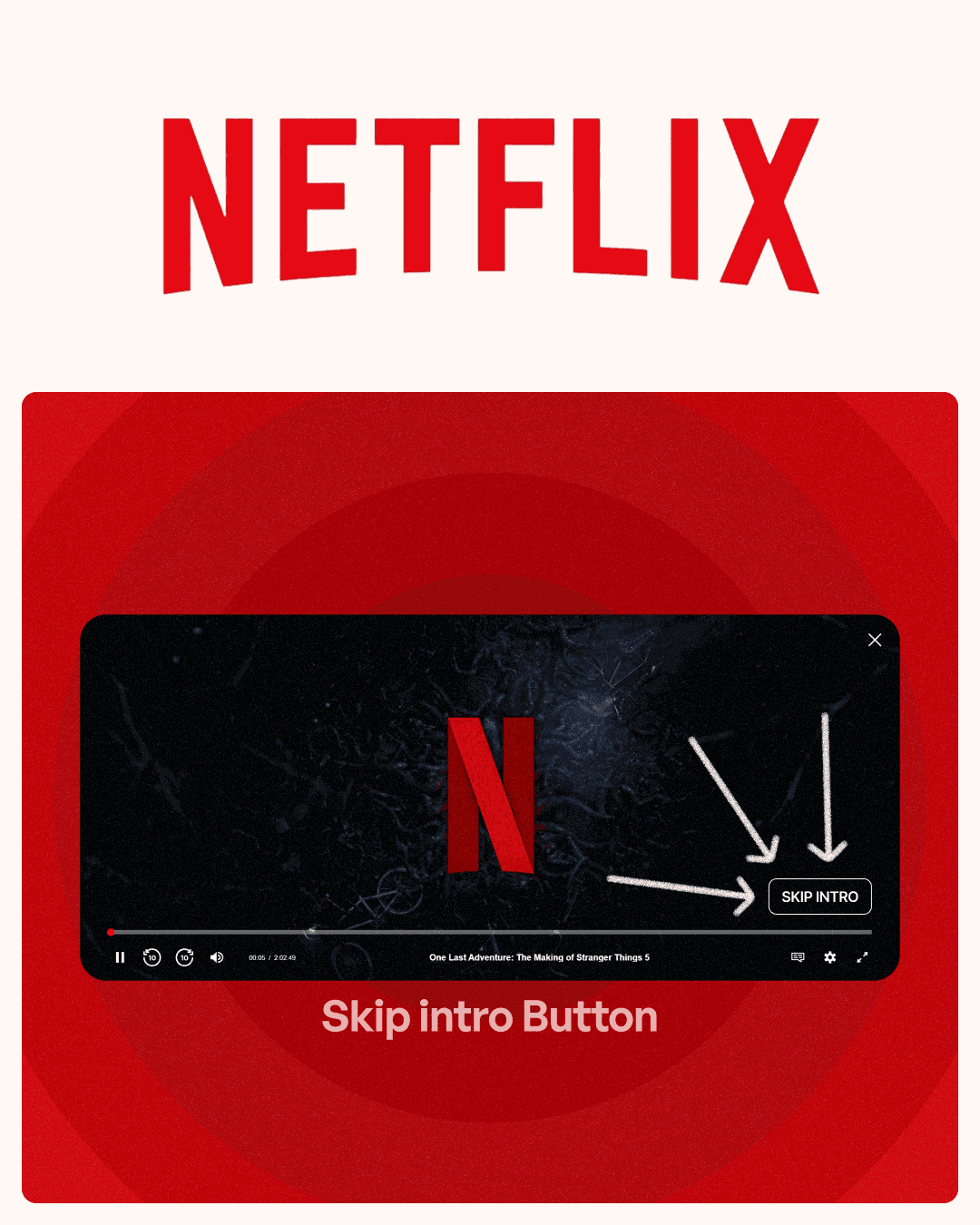
A single button.
Skip Intro.
That's it.
The Power of Solving Small Frustrations
Many companies believe innovation requires massive changes.
New features.
New screens.
New technology.
But some of the biggest UX wins come from solving tiny problems.
The Skip Intro button is a perfect example.
It didn't introduce a new streaming technology.
It didn't change the Netflix business model.
It didn't require users to learn anything new.
It simply removed an unnecessary step.
And because Netflix serves millions of users globally, saving a few seconds for each user created a massive improvement in the overall experience.
This is one of the most important UX principles:
Small friction multiplied by millions of users becomes a big problem.
Small improvements multiplied by millions of users become a big win.
UX Design Is About Understanding Intent
Users always have a goal.
In UX design, understanding that goal is critical.
For Netflix users, the goal is not:
❌ Watch intros repeatedly
❌ Navigate menus endlessly
❌ Search through unnecessary screens
The goal is:
✅ Watch content
Everything that supports that goal improves the experience.
Everything that delays that goal creates friction.
The Skip Intro button works because it aligns the product with user intent.
It helps users get to what they actually came for.
Why Great UX Often Looks Simple
One of the biggest misconceptions in product design is that great UX should look impressive.
In reality, the best UX often goes unnoticed.
Users don't praise the Skip Intro button because it's visually stunning.
They appreciate it because it removes a problem.
That's why many successful UX solutions look deceptively simple.
Examples include:
One-click checkout on e-commerce sites
Face ID authentication
Auto-save in cloud applications
Smart form validation
Autofill suggestions
Skip Intro on Netflix
These features don't attract attention.
They eliminate frustration.
And that's exactly why users love them.
The Difference Between UI Design and UX Design
This example also highlights the difference between UI and UX.
UI Design focuses on how things look.
Colors
Typography
Components
Visual hierarchy
Layouts
UX Design focuses on how things work.
User goals
Friction points
User flows
Decision-making
Task completion
The Skip Intro button required both.
UI designers created the visual button.
UX designers identified the problem worth solving.
Without UX thinking, the button would never have existed.
How Designers Can Apply This Thinking
Many designers spend their time asking:
"How can I make this screen look better?"
A more valuable question is:
"What is frustrating users right now?"
Great UX designers constantly look for moments where users:
Hesitate
Repeat actions
Get confused
Abandon tasks
Create workarounds
These moments reveal opportunities for improvement.
The goal isn't to add more design.
The goal is to remove unnecessary effort.
Sometimes the best design decision is adding a new feature.
Sometimes it's removing a step entirely.
The Real Job of a UX Designer
A UX designer's job isn't to create screens.
It's to solve problems.
That requires understanding:
User behavior
User goals
Business objectives
Context
Friction points
The visual interface is simply one of many tools available to solve those problems.
The most successful products are rarely the ones with the most features.
They're the ones that make achieving a goal feel effortless.
Netflix's Skip Intro button is proof of that.
Final Thoughts
The next time someone asks what UX design is, don't show them a design system.
Don't show them a wireframe.
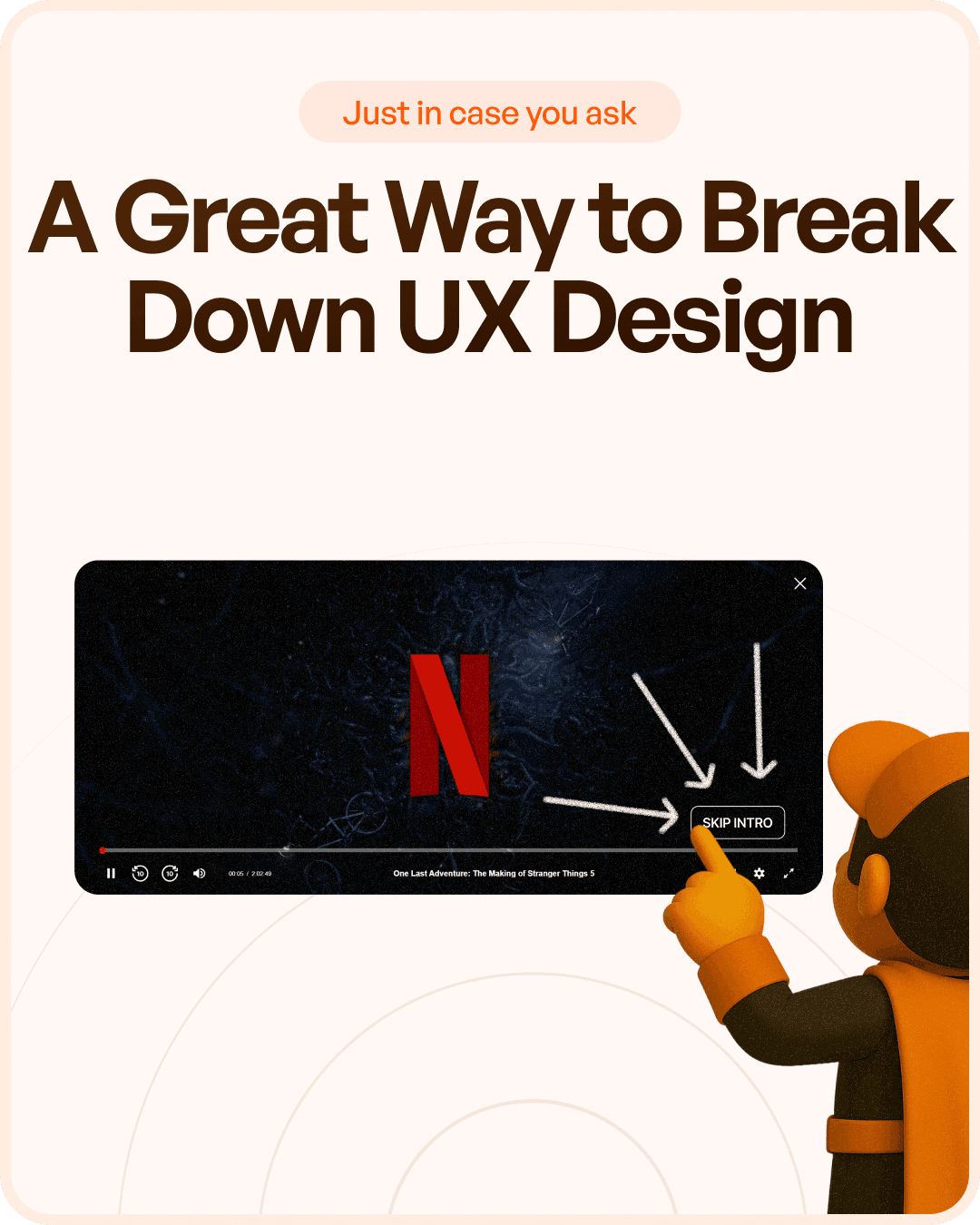
Show them Netflix's Skip Intro button.
Because UX design isn't about creating buttons.
It's about understanding what users want and removing anything that stands in their way.
That's why great UX often feels invisible.
Users don't notice the design.
They notice that everything feels easier.
And that's the highest compliment a product can receive.


